Friday, April 13, 2007

Tips for aspiring jinashi shakuhachi makers

Occasionally, an aspiring shakuhachi maker asks for advice. These are some ideas which have proved important to me.


* Develop an understanding of the physics of wind instruments. Put it to practice. Realize what happens and why when any action is taken.

* Work with the idea of taking the path of least resistance. Since everything is connected, take action that will solve multiple problems. Juggle efficiently. Apply the least amount of action to make the best possible flute.

* Think big. Imagine the impossible. If one note plays particularly well. Imagine a flute where everything plays as well.

* Understand that there is no one ideal flute design. There are many different kinds of sounds that are satisfying.

* Realize that shakuhachi making is a matter of life and death.

* Play a lot. Find people who play better than you. Your flute making will improve dramatically.

* Work with responsibility. (This can not be overemphasized) You are representing an honorable profession. Understand your duty.

* Don't pose or misrepresent yourself. You'll disgrace yourself as well as other makers. You'll let down the bamboo. Allow yourself to develop honestly.

* Develop thick skin. Serious shakuhachi making will shatter your confidence. Persevere. You'll become stronger.

* Work with the bamboo and not at it.

* Approach each flute as a beginner, without pretense.

* With time and effort you'll develop your own sound. Use it to take the shakuhachi further.


Shakuhachi advice in video.

Taimu CD Now Available


BUY IT HERE


Check out the TAIMU RECORDING PHOTOS

Mujitsu Taimu shakuhachi are featured exclusively on a new album "Taimu" by Brian Tairaku Ritchie and Shakuhachi Club Milwaukee. Joining SCM is John Sparrow on percussion and Dave Gelting on upright bass. Together, they create a cohesive blend of jazz, blues, traditional Japanese Honkyoku and improvisation.


-------------------------------------------------------------------------
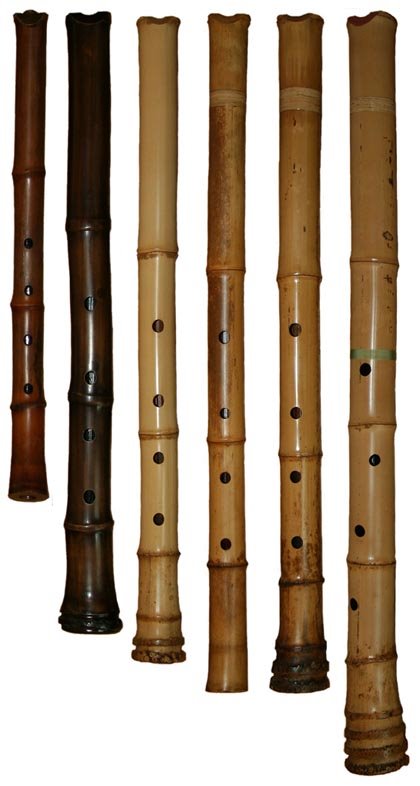
Standard 1.8 (for comparison), Taimu 2.3, 2.45, 2.7, 2.7, 3.0.


About the flutes on this recording:

The shakuhachi flutes used on this recording are a unique style of long, wide flute called Taimu. They are the current result of my longtime maker/player collaboration with Brian Tairaku Ritchie. The name was formed by combining Brian's professional name Tairaku with my shakuhachi making name Mujitsu. Translated, Taimu means The Big Nothing.

From the beginning of this collaboration, it has been evident to both Brian and me that there is something special about wide bore shakuhachi. The complex, expressively raw tone possible with these flutes is very different than the focused, pure tone of modern, thinner bore shakuhachi. Much of the development of Taimu Shakuhachi centers on expanding this complex tone while maintaining a musically sound instrument. This recording is an effort to introduce the many possibilities of this unique style of shakuhachi.

-Ken Mujitsu LaCosse


Tracks on "Taimu"

1 tairaku no cho
2 mujitsu blues
3 space coconut
4 evidence
5 change has come
6 john the revelator
7 "L" dance
8 echigomeianji hachikaeshi
9 banshiki
10 horagai
11 sogei no kyoku
12 reibo

Taimu - The Expressionist Painting of Shakuhachi

Hello,

I thought I'd write a little about what I'm trying to do with Taimu Shakuhachi. 'Taimu' (The Big Nothing) refers to very wide bore shakuhachi

One way to think of shakuhachi, in a design sense, is that it has a window of bore/length possibilities. (some refer to this as aspect ratio) A thinner bore to length ratio usually results in a focused, cleaner tone. A wider bore to length ratio usually results in a breathier tone. Going too far in any direction results in poor tuning and tone. A bore/length ratio in the middle results in better odds for good octave tuning without extensive bore work.

With Taimu Shakuhachi, I'm trying to push the bore width/length ratio as far as possible. I'm looking for an expressive, breathy foghorn tone as well as good tuning. In a sense, this is like shooting oneself in the foot from the start. To find the tone color desired, the widest bore/length ratio possible has to be used. Therefore, the tuning in the second register often requires quite a bit of bore work to bring into tune.

Concerning tone, while working the bore, I'm looking for the point where the tone suddenly improves dramatically into a glowing, vibrating foghorn. This is achieved by the right combination of adjustments of nodes, choke point, blowing end and rootend diameter as well as hole size and undercutting.

The challenge is trying to get as close as possible to these ideals of tuning and tone color.

Taimu Shakuhachi design differs from many of the 'Hocchiku' Shakuhachi currently in vogue. First, the Taimu bore/length ratio is slightly wider. The bottom end of the bore is opened up to increase tone projection. The holes are also much larger and severely undercut.

These design differences often make this style of flute difficult to make. However, if it can be pulled off, the results can be very powerful.


Ken

Thursday, November 03, 2005

Shakuhachi Forum

Just a note to let everyone know about the new Shakuhachi Forum. Discuss the shakuhachi flute with enthusiasts around the world. Check it out!

Friday, June 17, 2005

Thank you!

I wanted to thank everyone who attended the benefit
shakuhachi concert on Tuesday with Brian Tairaku Ritchie, Kiku Day and
Shakuhachi Club SFO.

The turnout was fantastic. The vibe was positive. We raised plenty of
funds for the ARDS Foundation and we all had the opportunity to hear
some inspiring music! Thank you all so much for being part of it and
for making these events possible!

All the best,

Ken LaCosse

Thursday, June 02, 2005

Shakuhachi Benefit Concert Announcement!!

Hello everyone,

I would like to announce and invite you to a benefit shakuhachi concert that I am organizing in San Francisco.

On Tuesday, June 14, please join Brian Tairaku Ritchie in "A Performance of Shakuhachi - The Japanese Bamboo Flute." Also appearing will be guest performers Kiku Day and Shakuhachi Club SFO.


Brian and Kiku will be playing honkyoku (a zen inspired, meditative style of Japanese shakuhachi music). Shakuhachi Club SFO will be performing jazz and rock music with the shakuhachi in the lead.
As a flute-maker, I've worked closely with Brian while developing a unique style of large, wide, bass shakuhachi. This concert is an effort to promote this style of windy, expressive shakuhachi.

This concert is also an effort to promote a worthy cause. All proceeds go to the ARDS Foundation.
As an ARDS survivor (Acute Respiratory Distress Syndrome), this benefit has particular meaning for me.The ARDS Foundation has been very helpful in my recovery. Organizing this concert is an opportunity for me to show my appreciation for their support.

This is a great opportunity to hear a number of very talented and generous musicians. I hope to see you there!


All the best,

Ken

---------------------------------------------------
Date:
Tuesday, June 14. 8pm.
Location: Suginami Aikikai, 141 - 11th St. @ Mission Street, San Francisco
Price: $10 Donation at the door. All proceeds go to the ARDS Foundation.
For more concert information, please visit: http://mujitsu.com/concert.html
or call me at: 415 242-0919

Monday, May 30, 2005

Form or Emptiness?

Are you bird or sky?

A common subject of debate among shakuhachi enthusiasts is the question, "What makes a shakuhachi sound the way it does?" Is it the bamboo? Is it the empty space inside the vessel? Is it the player? Is it the maker? Is it a combination of all of these? Or none?

At one time or another in my shakuhachi life, I've embraced most of these beliefs. I have also been fascinated by the various opinions I've heard from players, makers, beginners and zen tricksters alike. Let's look at a composite of our opinions.

Bamboo

Bamboo is the stuff that the shakuhachi is made of. If you blow through different types of bamboo, you'll discover different sounds. Soft bamboo absorbs sound. Hard, dense bamboo reflects sound. Each piece is blessed with organic uncertainties and therefore has a unique tonal identity. It you make thousands of flutes from a variety of bamboo you'll eventually discover that bamboo of a specific type makes consistently superior shakuhachi. This is especially true for natural bamboo bore, jinashi shakuhachi.

Emptiness

The shakuhachi sound is a result of the amount of nothing inside the vessel. Any hard material will do to contain this space. With this approach, specific tonal styles of shakuhachi can be designed and manufactured using precise measurements. Flutes adhere to physical laws. Once we understand them we can put the right amount of nothing where it is needed most.

The Player

The player makes the flute come alive. A crude broomstick shakuhachi becomes a work of art in the hands of a master player. The finest museum quality shakuhachi is useless in the hands of a novice. The shakuhachi is a stick with five holes. A player is a human being with years of fertile experience.

The Maker

The maker has an intimate relationship with all aspects of the instrument and acts as a midwife in the life of the flute. The direction and level of understanding of this relationship varies among makers. Makers also have a variety of interests when it comes to tone color. If you give one thousand makers identical PVC plastic materials and precise specs, the result will be one thousand unique voices.

All of the Above

The shakuhachi sound comes from everything involved. Bamboo, negative space, players and makers do not exist in a vacuum. One element can not be removed or isolated. It is their inter connectivity that is responsible for the shakuhachi sound.

None of the Above

Ultimately, the origin of the shakuhachi sound has nothing to do with form, emptiness, players or makers. These are terms that are all one. It is the wrong question. It is like asking if the foot or hand is more responsible for human existence. It is beyond intellect and knowledge. Used correctly, it is one of many clues available to penetrate inner mysteries. It is a path used to bring forth something inconceivable.

So, what makes the shakuhachi sound the way it does? Although these arguments are exaggerated slightly for effect, they suggest that the question can only be answered in relative terms. Is relativity the easy way out? Does it matter? What do you think?


Wednesday, April 06, 2005

Fine Tuning the Shakuhachi

Here are a few thoughts about fine tuning the bore of the shakuhachi. You can download more information about shakuhachi making here. You'll need acrobat reader to access the file.

Fine tuning the bore is the main challenge in constructing a quality shakuhachi. It is a combination of mathematics, luck, educated guess, intuition, patience and perseverance.

This process is, essentially, adding and/or preferably removing space along various areas of the bore until all the tones play well. The actual space along the bore that will need to be removed or added will most likely be minute, but nonetheless, critical to the potential sound quality of the instrument.

Each note has corresponding 'critical points' along the bore which can be adjusted to affect the tone. For the low octave notes, these points are found at the 1/2 point between the blowing edge and the open hole of the note being played (1/4 & 3/4 points for second octave), as well as directly under the open hole. If a particular note is not playing well, it can be corrected by adding or removing space at one or more of these areas. To check if space needs to be added, fold up a small piece of wet newspaper (approximately 1 1/2" by 1/2") and apply it to the 1/2 point in the bore. Play the flute to check for tone improvement. (A long split bamboo stick with foam rubber tied to the end works well to slide the newspaper to the desired spots.) If it improves the tone, the newspaper can be removed and the area can be built up with a dab of glue and sawdust, ji paste, or paste resin. If there is no tone improvement, try adding newspaper to the other critical points. Then try adding in different combinations, then at every centimeter along the bore. You can also experiment with smaller or larger pieces. If there is no improvement after exhausting all the possibilities, you will need to remove space at one or more of the critical points. Various tools will work to remove space. You can wrap a thin strip of coarse sandpaper around the end of a dowel or weld a 1/2" section of a bastard file to a metal rod. A dremel sanding drum bit on the end of a long rod also works well. If the tone improves after grinding one or more critical areas, stop and move on to the next note that needs improvement. If there is still no improvement or the tone sounds worse, the areas will need to be refilled. It is also possible that a combination of adding and removing will be needed. This is where experience helps. A good rule of thumb is to exhaust every possible simple solution before attempting the complicated combinations. Altering the critical points for one tone can also affect the other notes as well so it is important to work slowly to get a feel of what is happening to the flute on a whole.

It takes patience and experience to develop a mental map of the shakuhachi bore using this fine tuning method. It may be helpful to work a little every day or two to slowly get to know the peculiarities of each flute. Each is unique, requiring an approach which is beyond pure mechanics. The shakuhachi is much more than physics. Listen to the bamboo.

Wednesday, March 23, 2005

Shut up and Breathe


In spring of 2002, I was in the hospital with a condition known as Acute Respiratory Distress Syndrome (ARDS). ARDS is a life threatening injury to the lungs which often requires mechanical ventilation during a drug induced coma. It is often brought on by a severe trauma to the body; car accident, fall, heart attack, or in my case, pneumonia.

Most ARDS patients experience vivid, life transforming dreams and hallucinations during their ordeal. Many of these visions are terrifying and horrific; some are heroic, epic and life affirming.

An enduring, life affirming theme that helped sustain me throughout my experience involved the shakuhachi.

Anyone who has picked up a shakuhachi has experienced that rare moment when playing is effortless. Some refer to this moment as Blowing Zen. Regardless of the label, it is an experience that is outside of self, skill, opinion and intention.

The most important moment in my life occurred during my hospital stay. I was in bad shape, and I knew it. It was very difficult to breathe and I was aware that I might die. I felt an overwhelming sense of fear, horror and guilt. The thought occurred that I could give up, avoid my predicament and die.

I also thought about those perfect moments with the shakuhachi and how it was necessary to apply their tangible lessons immediately. I remembered how the most difficult things are actually the easiest because they are directly in front of our eyes. I also remembered that in order to play well, or make a good flute, one must take the path of least resistance.

The shakuhachi was finding its way into a horrific moment of despair and transforming it into a heroic experience. I was learning to shut up and breathe. I was realizing that I wanted to live and I was learning how to do it.

This life affirming experience continued to provide strength for me through many dark periods of my illness and recovery. The shakuhachi continues to teach without trying. Its humble presence has instilled a daily reverence for sacred responsibility in my life . It is a gift for which I am forever grateful.

As I look back on my experiences with bamboo, I often wonder about what the shakuhachi is and what it means to me. I also think about how my relationship with bamboo has evolved over the years.

When I began making shakuhachi, I felt that the essence of this mysterious instrument was hidden in the bamboo. Eventually, I learned something of physics and deduced that its secret was found not in form, but in emptiness. After exhausting my interest in a scientifically weighted approach, I sought the middle way and learned that the shakuhachi was about both bamboo and emptiness. Now, after listening closer, I hear it is about neither.

Breathe well.

Ken LaCosse